Albert Pike and Freemasonry Conspiracy Theories | Achla News
Opinion
Albert Pike and Freemasonry Conspiracy Theories
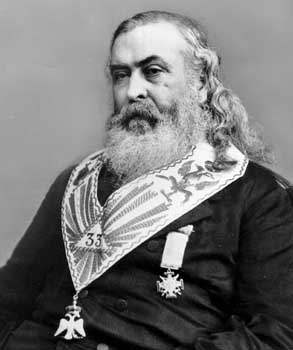
Albert Pike was not a “fake Freemason,” but one of the most misrepresented figures in Masonic history. Conspiracy theorists often portray him as the Grand Master of Freemasonry and a Satanist, mixing facts with later conspiracy theories.
Albert Pike was not a “fake Freemason,” but one of the most misrepresented figures in Masonic history. Conspiracy theorists often portray him as the Grand Master of Freemasonry and a Satanist, mixing facts with later conspiracy theories.
Pike joined Freemasonry in 1850 and became Worshipful Master of his lodge that year. He later entered the Scottish Rite and served as Sovereign Grand Commander of its Southern Jurisdiction from 1859 to 1891. But he led one U.S. Scottish Rite jurisdiction—not Freemasonry worldwide.
His famous Morals and Dogma, often cited by anti-Masons, is not a universal Masonic handbook. It explains Scottish Rite degrees while presenting Pike’s own philosophical, religious, and esoteric ideas. It states:
“Everyone is entirely free to reject and dissent from whatsoever herein may seem to him to be untrue or unsound.”
Léo Taxil played a major role in Pike’s Satanic image. The French writer fabricated stories about secret devil and Lucifer worship within Freemasonry and linked prominent Masons such as Pike to them. But on April 19, 1897, Taxil publicly admitted in Paris that these stories were false—the famous Taxil Hoax.
Still, not everything esoteric attributed to Pike was invented. Morals and Dogma discusses ancient religions, comparative religion and mysticism, and Pike does mention Lucifer. Thus, Taxil spread false claims about Lucifer worship, but Pike’s own religious philosophy differed from orthodox Christianity.
Another famous claim is that Pike planned three world wars in an 1871 letter to Giuseppe Mazzini. No authenticated original of this supposed “Pike–Mazzini letter” has been found, nor has the claim that it was kept in the British Museum Library been substantiated.
The alleged letter says:
“The Second World War must be fomented by taking advantage of the differences between the Fascists and the political Zionists... so that Nazism is destroyed and... political Zionism [can] institute a sovereign state of Israel in Palestine.”
This creates major chronological problems. Zionism as a modern political movement emerged in the late 19th century, and Nathan Birnbaum’s use of the term in 1890 is among its earliest modern usages. “Political Zionism” in a supposedly 1871 document therefore seriously undermines its authenticity.
Fascism and Nazism require more nuance. Terms such as fascio existed before Mussolini, although modern Fascism developed after 1919. Likewise, “Nazi” was used in the 1920s, not first invented in the 1930s. But neither supports the authenticity of a supposed 1871 prediction of specific 20th-century conflicts.
Ultimately, Pike was a powerful Freemason, and Morals and Dogma contains unusual religious and mystical ideas. But he was not the Grand Master of worldwide Freemasonry, his writings do not prove that Freemasonry as a whole worships Satan, and there is no authenticated evidence that he wrote an 1871 letter predicting three world wars.

Loading comments...