Apple and manufacturing partner Foxconn worked with a vast network of component suppliers, providing expertise needed to satisfy Apple's standards for quality, precision, cost and production volume.
That strategy made business sense for Apple. Developing more suppliers increased competition and could lower component costs. But it also produced a major strategic consequence: Chinese manufacturers accumulated manufacturing knowledge that could be used outside Apple's supply chain.
Critics argue that the same industrial ecosystem that made iPhones cheaper and easier to manufacture also strengthened companies capable of supplying Apple's Chinese competitors. Huawei, Xiaomi and other Chinese electronics manufacturers benefited from a domestic supply base that became steadily more capable.
Some of the strongest allegations go further. Commentary surrounding Apple's China strategy has accused the company and its manufacturing ecosystem of helping Chinese suppliers acquire expertise involving sophisticated glass, displays and precision-assembly processes.
BOE Technology, China's display giant, has been a particular focus of this criticism. Claims surrounding Apple's supplier-development efforts describe extensive training of BOE personnel and assistance involving advanced manufacturing and display-production processes. Allegations have also been made over whether knowledge originating with other American and Asian technology companies ultimately benefited Chinese manufacturers.
One frequently cited episode involves GT Advanced Technologies, the American sapphire-glass company that entered a major manufacturing partnership with Apple before filing for bankruptcy in 2014. Critics of Apple's China strategy have pointed to the subsequent development of Chinese capabilities in related manufacturing fields as another example of the danger of concentrating advanced production knowledge inside China's industrial ecosystem.
Those accusations should be distinguished from established findings that Apple deliberately transferred another company's protected trade secrets. What is much clearer is the larger outcome: Apple spent years helping create and refine a Chinese supplier network capable of manufacturing some of the world's most sophisticated consumer electronics.
A $275 Billion Relationship With Beijing
The scale of Apple's commitment went far beyond individual factories. Reporting on internal Apple documents has described commitments worth more than $275 billion over a five-year period beginning in 2016 as the company worked to maintain its position in China and address pressure from Beijing.
For comparison, that figure is more than twice some inflation-adjusted estimates of the roughly $130 billion value of the post-World War II Marshall Plan.
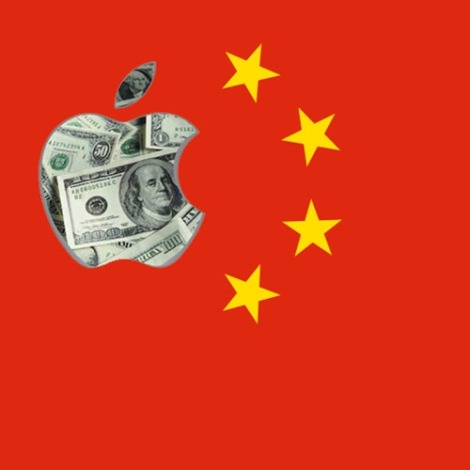
The enormous commitment illustrates the central contradiction in Apple's China strategy. The company gained access to extraordinary manufacturing capacity and one of the world's largest consumer markets, but that success also made Apple increasingly dependent on China.
At the height of that dependence, estimates commonly placed the overwhelming majority of Apple's manufacturing footprint in China, although Apple has since accelerated diversification into countries including India and Vietnam. The deeper problem cannot be measured only by final assembly: many suppliers, components, tools and specialized manufacturing capabilities remain tied to the Chinese industrial ecosystem.
That gives Beijing leverage. Moving an assembly line is one thing. Recreating an entire network of trained workers, specialized suppliers, tooling companies, component manufacturers and logistics operations is considerably harder.
When Beijing Demanded Changes, Apple Complied
Apple's dependence became especially controversial when the Chinese Communist Party demanded changes affecting information and data.
In 2017, Apple removed The New York Times applications from its Chinese App Store after Chinese authorities said the apps violated local regulations. Apple has removed numerous other applications from its Chinese storefront over the years in response to government requirements.
The company's handling of Chinese iCloud accounts generated even greater concern. To comply with Chinese regulations, Apple moved Chinese customers' iCloud operations to infrastructure operated in partnership with Guizhou-Cloud Big Data, a state-owned Chinese company, with Chinese users' data stored inside China.
Critics warned that the arrangement weakened the practical protections separating Chinese authorities from user information and placed data within a legal system where government demands carry enormous power. Apple has maintained that it retains strong security controls and has said it has never created a backdoor into its products.
The controversy nevertheless exposed an uncomfortable conflict between Apple's global marketing around privacy and the concessions required to remain in the Chinese market.
The Supply Chain Became a Competitor
The strategic consequences are now becoming clearer. China no longer wants merely to assemble products designed in California, South Korea or Japan. Beijing wants Chinese companies to control the technologies inside those products.
Huawei has demonstrated China's ability to remain competitive despite extensive U.S. restrictions. Xiaomi has become a major global smartphone manufacturer. BOE has emerged as one of the world's most important display producers. Chinese semiconductor companies are pushing into memory and other strategically important chip markets.
That creates an uncomfortable irony for Apple: the suppliers and industrial capabilities cultivated to reduce Apple's costs can also support companies competing directly against it.
The same issue matters greatly to South Korea. Samsung and LG have faced increasingly capable Chinese rivals in displays and consumer electronics, while Samsung and SK Hynix must now watch China's efforts to expand in memory semiconductors.
Memory Chips Could Be the Next Front
CXMT's expansion demonstrates why the debate is no longer limited to smartphones and displays. China is attempting to establish itself in advanced memory at a time when artificial intelligence has made memory technology strategically critical.
Reports and industry discussion have also focused on Apple's interest over the years in adding Chinese memory suppliers to its supply chain. Apple previously explored using memory from China's YMTC, a move that generated significant political opposition in Washington before U.S. restrictions tightened around the company.
Claims that Apple specifically sought CXMT DRAM should be treated separately unless confirmed by authoritative corporate or regulatory reporting. But the broader issue remains: Apple's enormous purchasing power can transform a supplier. Winning Apple business provides not merely revenue, but manufacturing scale, experience and credibility.
That is precisely why Washington increasingly views supply-chain decisions involving advanced Chinese semiconductor companies as national-security questions rather than ordinary corporate purchasing decisions.
Washington Is Paying Attention
The United States has increasingly restricted China's access to advanced semiconductors, semiconductor manufacturing equipment and technologies with potential military applications. Washington's objective is to prevent American technology and capital from accelerating capabilities that could strengthen the People's Liberation Army or undermine U.S. technological leadership.
BOE has also faced scrutiny in Washington over alleged links to China's military-industrial system. Proposals to impose tougher restrictions have created a direct collision between national-security concerns and the commercial interests of American companies that depend on Chinese suppliers.
Apple's role in those debates is particularly sensitive because few American corporations have built a deeper relationship with China's manufacturing sector.
Why Trump Has Put Apple Under Pressure
President Donald Trump has repeatedly pushed Apple to manufacture more of its products in the United States rather than relying heavily on China and other overseas production centers.
The political argument goes beyond where an iPhone is assembled. From an America First perspective, decades of offshoring transferred manufacturing capacity, supply-chain knowledge, employment and industrial leverage away from the United States while strengthening its most important strategic competitor.
Tariffs create another complication. Applying heavy duties to imported iPhones could raise prices for American consumers before Apple has a realistic domestic alternative. That leaves Washington balancing two objectives: reducing dependence on China without imposing excessive short-term costs on Americans.
Trump's pressure on Apple reflects a broader attempt to change that calculation. Cheap production is no longer automatically treated as a sufficient reason to place strategically important manufacturing overseas.
The Cost of Short-Term Thinking
Apple's strategy reflected a model of corporate management that rewarded lower costs, higher margins and greater shareholder returns. From a narrow business perspective, building an enormous Chinese supply chain was extraordinarily successful.
The national-security calculation looks different.
Every supplier developed to reduce Apple's costs could also add another piece to China's industrial base. Every manufacturing process mastered inside China reduced the technological advantage once held by the United States and its allies. As Chinese suppliers became stronger, Apple's own dependence on the ecosystem increased.
This creates a long-term risk even for Apple. A company can spend decades training and expanding a supply chain only to discover that the same ecosystem can eventually produce formidable competitors.
South Korean companies face the same danger from the other side. Samsung, SK Hynix and LG have watched Chinese companies advance in smartphones, displays, batteries and semiconductors, often with enormous state support behind them.
The Bigger Question for America
The Apple-China story is ultimately bigger than Apple.
For decades, American corporations operated on the assumption that maximizing efficiency and reducing production costs would ultimately benefit shareholders and consumers. China offered labor, scale and government-backed infrastructure that were difficult to match.
But technology transfer and supplier development do not happen in a geopolitical vacuum. Manufacturing expertise is strategic power. Semiconductor capacity is strategic power. Control over components, data infrastructure and supply chains is strategic power.
China understood that equation and spent years moving from assembly toward technological independence.
Now CXMT's advance in memory chips, BOE's position in displays, Huawei's resilience and the broader rise of China's electronics industry show where that road can lead.
Apple did not single-handedly create China's technological power, and China's rise cannot credibly be reduced to the actions of one American corporation. Beijing invested enormous state resources, Chinese companies developed their own capabilities, and countless multinational corporations moved production there.
But Apple's scale made its choices unusually consequential. Its search for lower costs helped build an extraordinary manufacturing network in China. The skills, suppliers and industrial capabilities developed around that network did not remain exclusively Apple's advantage.
They became part of China's advantage too.
That is the warning for Washington today: America's greatest corporations can pursue short-term commercial efficiency while creating long-term strategic vulnerabilities. The challenge now is ensuring that the next generation of critical American technology strengthens the United States and its allies rather than building the industrial power of their principal strategic competitor.

Loading comments...