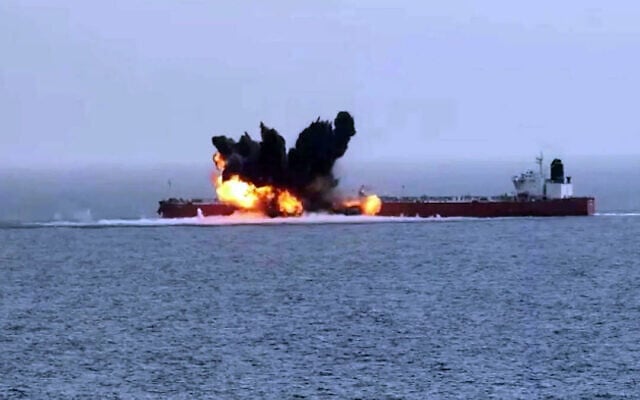
A tanker was reportedly struck by an unidentified projectile in the Red Sea near Saudi Arabia, triggering an onboard fire. Iran-backed Houthi terrorists later claimed an operation against two Saudi tankers as Tehran threatened regional energy infrastructure and President Donald Trump warned of further U.S. strikes.
Regional tensions intensified after a tanker was reportedly hit in the Red Sea southwest of Saudi Arabia while the military confrontation between the United States and Iran continued.
According to Reuters, the United Kingdom Maritime Trade Operations agency received a report on July 23 of an incident roughly 130 kilometers southwest of Al-Shuqaiq, Saudi Arabia.
The ship’s captain reported that the tanker had been struck by an unidentified projectile, causing a fire onboard. Crew members were working to extinguish the blaze.
No casualties, oil spill, or other marine pollution had been reported at the time of the initial account.
Houthis Claim Operation Against Two Saudi Tankers
Shortly after the maritime incident was reported, Yemen’s Iran-backed Houthi terror group claimed that it had carried out a military operation targeting two Saudi tankers.
The Houthis identified the vessels as the Encela and the Laylia, claiming that the ships had violated a maritime blockade announced by the group.
The Houthis declared the blockade on July 20 in response to Saudi restrictions on ports and airports and an alleged strike on Sanaa Airport.
Saudi authorities had not issued an official response to the Houthi claim. It also remained unclear whether the tanker incident reported by UKMTO involved either of the two vessels named by the terror group.
If confirmed, the attack would mark the first reported strike on commercial shipping since the Houthis announced their latest blockade.
Trump Warns Iran Over Attacks in the Strait of Hormuz
The reported Red Sea attack came as President Donald Trump issued a direct warning to Tehran over threats to shipping through the Strait of Hormuz.
Trump said that each Iranian attack on a vessel could bring the destruction of an Iranian bridge, power station, or other strategic target. He also said Iran had suffered severe damage and would eventually be forced to negotiate.
“Iran has been hit tremendously, so they want to negotiate. But I don’t think they are ready yet,” Trump said, according to the supplied report.
Iranian officials responded with additional threats against international energy supplies. Iranian parliament speaker Mohammad Bagher Ghalibaf reportedly said that if Iran could not sell oil, no other country in the region would be allowed to do so.
Iran’s military also threatened regional oil and gas facilities, warning that no crude oil would be exported if U.S. threats were carried out.
Reports of Possible Strike on Underground Nuclear Site
Israel’s Kan public broadcaster reportedly said that Washington had informed Israel of plans for a possible strike on a suspected underground Iranian nuclear facility near Natanz.
The site, sometimes referred to as “Pickaxe Mountain,” is believed to contain deeply buried infrastructure. Iran denied that nuclear activity was taking place there and accused the United States and Israel of inventing a justification for an attack.
The report suggested that B-2 stealth bombers carrying bunker-busting weapons could be used. However, questions remain over whether conventional airstrikes could penetrate the site’s depth and hardened rock.
Iran-Backed Threat Expands Across the Region
Iran also claimed that its forces had attacked a U.S. base in Jordan, destroying drones and helicopters and causing American casualties. That claim was not independently confirmed in the supplied material.
The confrontation has already increased pressure on global energy markets. The supplied report said Brent crude rose to $94.07 per barrel, while West Texas Intermediate reached $86.83.
Secretary of State Marco Rubio called on U.S. allies, particularly countries heavily dependent on Gulf energy routes, to contribute naval assets to the protection of commercial shipping.
The developing crisis highlights the wider danger posed by Iran and its terror proxies. Tehran, the Houthis, Hezbollah, and other Iran-backed forces have repeatedly used attacks on civilian shipping and energy infrastructure to pressure the international community.
The United States and its allies cannot allow an Iran-backed terror network to hold the world’s shipping lanes hostage. Freedom of navigation must be defended, and attacks on commercial vessels must carry serious consequences.

Loading comments...