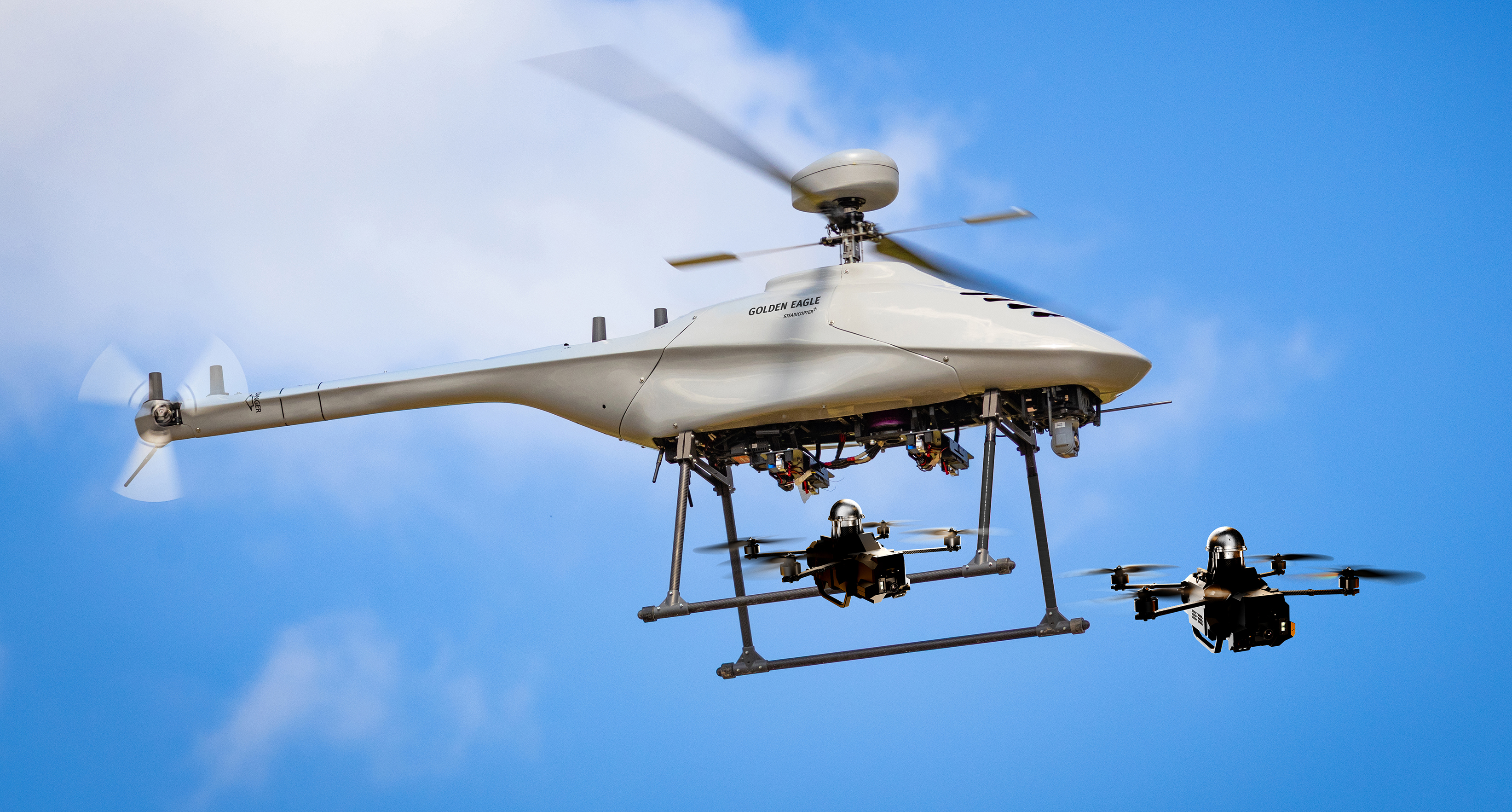
Steadicopter has unveiled a new “Mothership” concept for its Golden Eagle rotary unmanned aerial system. The setup is designed to carry and release small ISR drones, and potentially precision effectors, while keeping the main aircraft outside high-risk enemy engagement zones.
Israeli drone maker Steadicopter Ltd. has introduced a new operational concept for its Golden Eagle rotary unmanned aerial system, turning the platform into a long-range carrier for smaller unmanned assets in dangerous and contested environments.
The new “Mothership” approach is built around a simple idea: keep the main aircraft at a safer stand-off distance while sending smaller drones closer to the target area for intelligence collection, tracking, and possible precision action.
According to the company, today’s battlefield is increasingly shaped by layered air defenses, electronic warfare, and the risk of losing expensive aerial platforms. In that kind of environment, range and endurance are not enough. Forces also need close-up intelligence and fast action without putting larger aircraft or troops in unnecessary danger.
The Golden Eagle’s rotary-wing design gives it an advantage over fixed-wing drones in this role. Because it can hover steadily, the system can release smaller drones at specific locations with greater control.
This allows operators to insert micro-drones near terrain, buildings, maritime obstacles, or other cover. Low-altitude flight can also help the aircraft reduce exposure by using terrain masking during its approach.
The aircraft can also shift to higher altitude when needed, acting as a communications relay between the deployed drones and command centers. This gives the system two useful roles: low-level insertion and elevated communications support.
Designed for High-Threat Missions
Under the concept, the Golden Eagle could launch from ships or remote land sites, move toward the mission area from outside short-range air defense and MANPADS threats, and then release compact ISR drones closer to the target.
Those smaller drones would be able to fly lower and closer, using reduced acoustic and radar signatures to gather electro-optical and infrared imagery from inside the area of interest.
This extra layer of intelligence can help commanders confirm targets, follow movement, study activity patterns, and make faster decisions without exposing manned aircraft, ground teams, or the larger unmanned platform.
Optional Precision Effects
The architecture may also support the release of loitering munitions or armed micro-systems. In that setup, the Golden Eagle would remain outside the most dangerous engagement zones while smaller assets carry out precision effects at extended range.
Steadicopter says the aircraft’s hover stability is meant to support controlled and accurate release conditions during these missions.
Potential Uses at Sea and on Land
The company sees the concept as relevant for cross-border ISR, counter-A2/AD missions, maritime and coastal surveillance, special operations support, and infrastructure monitoring.
In naval missions, the system could approach coastal areas at low altitude, release ISR drones near shoreline targets, and then reposition higher to maintain communications coverage.
By combining rotary-wing maneuverability, modular payload deployment, endurance, and relay capability, the Golden Eagle Mothership concept offers a flexible model for operating in areas where enemy defenses make direct exposure too risky.
Steadicopter says the development reflects the need to adapt rotary unmanned systems to modern threats, where survivability, close-range intelligence, operational reach, and precision options must work together in one system.
Part of a Wider ISR Network
The architecture is also intended to connect with broader ISR networks, including multi-domain frameworks being developed by World View, an Ondas Holdings company. The goal is to link stratospheric, aerial, and data-driven sensing layers so forces can collect intelligence, assign tasks, and make decisions faster across multiple domains.
The concept is being presented ahead of UVID DroneTech 2026, the international unmanned systems and drone event scheduled to return to Israel in November for its 14th edition.

Loading comments...