Most people know that the political terms “Left” and “Right” originated during the French Revolution. Those favoring radical revolutionary change became associated with the Left, while supporters of monarchy and more conservative reform became associated with the Right.
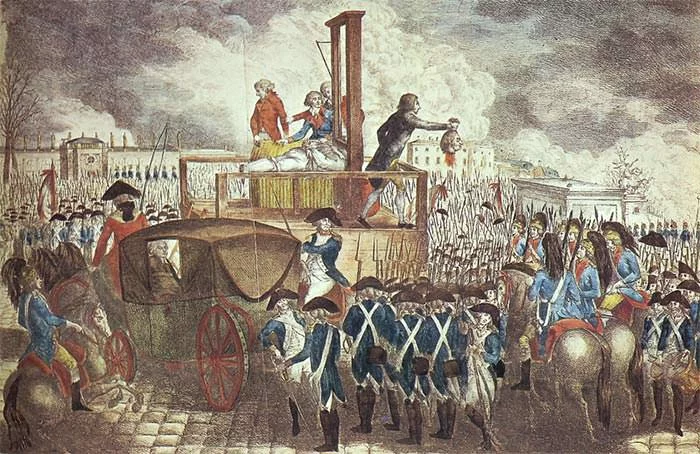
The Revolution teaches us that even when radical change begins with a seemingly noble cause, it can create consequences worse than the problems it sought to solve. Violence justified as necessary to prevent violence can become an endless cycle of bloodshed. Yesterday’s ally becomes today’s enemy, and today’s ally becomes tomorrow’s enemy. Throughout the Revolution, rival factions repeatedly sent one another to the guillotine.
There were also bitter power struggles involving Freemasons, the Illuminati, and revolutionary factions. The Duke of Orléans, a prominent Freemason connected to the Grand Orient, built his own political network and was suspected of ambitions involving the French throne. Yet Orléans himself eventually became a victim of the Revolution and was executed during the Terror.
Even among the Jacobins, fierce struggles developed around Danton, Marat, Robespierre, and their political allies. Revolutionary politics became a deadly contest over who would be sent to the guillotine next.
Robespierre, still in his mid-thirties, and Saint-Just, in his mid-twenties, were young intellectuals heavily shaped by political theory. They justified violence in the name of equality and a rational social order, helping legitimize the Reign of Terror. In the end, they themselves were condemned and guillotined.
From the Bolshevik Revolution of 1917 and Mao’s Cultural Revolution to radical Western counterculture, history has repeatedly shown the dangers of radical upheaval: national strength is exhausted, people are persecuted or executed, institutions are destabilized, and society can descend into chaos and political terror.
The same principle applies to economic policy. From the credit boom and collapse surrounding the 1929 crash to the Volcker tightening of 1979–82, the Latin American debt crisis of the 1980s, Japan’s boom and bust beginning in the early 1990s, and the 1997–98 Asian financial crisis, history shows how economies can suffer when years of easy money and credit expansion are followed by a rapid tightening of financial conditions.
High interest rates alone are not necessarily the problem. The speed of tightening matters. When abundant liquidity is withdrawn too quickly, the shock itself can become dangerous.
The broader lesson is simple: reforming society or solving complex problems too quickly creates unintended consequences. Good intentions are not enough. Lasting reform requires patience, restraint, and an understanding that the pace of change matters as much as its direction.

Loading comments...