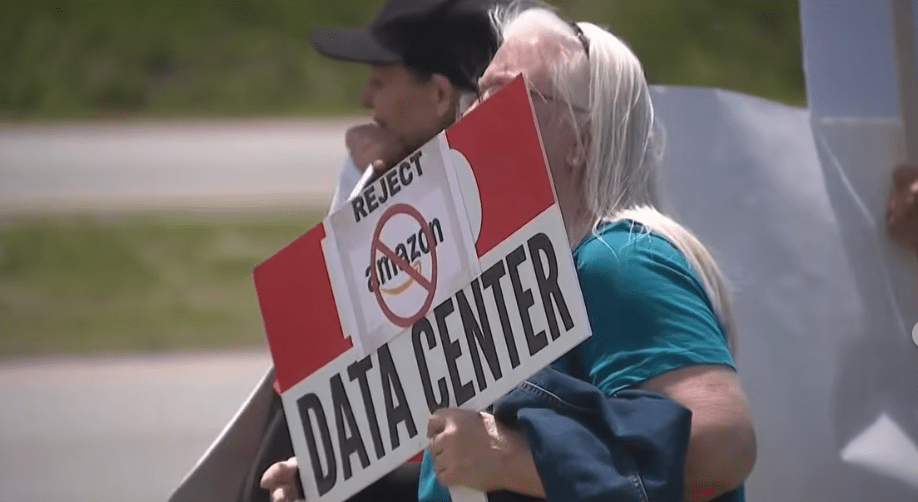
Demonstrators reportedly held 142 coordinated protests across 42 states, warning that the rapid construction of AI data centers could strain local water supplies, electricity grids, and the environment. While AI infrastructure is vital for America’s economy and national security, AchlaNews believes longer-term alternatives—including data centers at sea or in space—deserve serious development once major technical hurdles can be overcome.
The first nationwide series of coordinated protests against AI data center construction was held across the United States, according to Reuters and a report published by AI Times.
Organizers said 142 demonstrations took place across 42 states on the 18th. The protests reflect growing concern among both conservative and liberal communities that the rapid expansion of AI infrastructure is consuming local water and electricity, affecting the environment, and moving forward without enough public input.
Texas reportedly hosted the largest number of demonstrations, with 18 events. Georgia followed with 11, California with eight, while Pennsylvania, Florida, and Indiana each recorded seven.
Residents Raise Concerns Over Water and Power
Protesters argued that large AI facilities can place significant pressure on water supplies and electrical grids while providing local residents with too little influence over major development decisions.
In Fredericksburg, Virginia, demonstrators used the slogan, “We live on water, not data.” In Atlanta, protesters declared that Georgia residents had never agreed to the construction of massive AI data centers in their communities.
In Kenilworth, New Jersey, residents gathered near city hall to oppose a proposed $1.8 billion AI data center. The project reportedly received planning approval in May, but more than 12,000 people later signed a petition opposing it.
In California’s Imperial County, about 50 people reportedly protested a planned data center expected to use approximately 260 million gallons—around 980 million liters—of Colorado River water each year. Demonstrators described the use of such large quantities of fresh water for AI operations as a “dystopian reality.”
Residents also gathered in Tyler, Texas, where organizer Eva Cardona said she was concerned about unregulated AI and the speed of data center development. She said she wanted to take direct action rather than limit her response to social media posts.
A Growing Bipartisan Political Issue
The nationwide action was organized by Humans First, a conservative civic organization that describes rapid AI infrastructure development as irresponsible and potentially harmful to civil liberties.
Co-founder Amy Kremer, who previously played a prominent role in the Tea Party movement, compared the emerging opposition to the early stages of the 2009 Tea Party movement. She argued that data center policy could become one of the most important political battles affecting Americans’ daily lives.
Organizers stressed that the campaign is not limited to one political party. Their central argument is that local residents often discover major data center plans only after developers and officials have already advanced the approval process.
Humans First does not support a nationwide moratorium on all data center construction. Instead, the group is calling for local control, greater transparency, environmental protections, compensation for affected communities, and stronger accountability for developers.
AI Infrastructure Remains Essential for America
The data center industry maintains that new infrastructure is necessary for the AI era. Technology companies need enormous computing capacity to develop and operate advanced AI models, online services, and national-security systems.
OpenAI, Anthropic, Google, Meta, and other major technology companies continue to expand their data center operations. Industry leaders argue that these facilities are essential for economic growth, innovation, and America’s ability to compete with China and other strategic rivals.
Josh Levi, president of the Data Center Coalition, said the industry is working with policymakers, communities, and residents to ensure that data centers provide local benefits while reducing negative effects.
The supplied report also said President Donald Trump criticized efforts in New York to halt data center construction. Trump argued that companies should cover the full cost of their water and electricity use, with additional financial benefits returned to state and local communities, rather than allowing officials to block development completely.
Development Must Protect American Communities
America cannot afford to surrender leadership in artificial intelligence. AI computing infrastructure is increasingly tied to economic power, military readiness, cybersecurity, scientific research, and competition with hostile regimes.
At the same time, local families should not be forced to absorb rising utility costs, depleted water supplies, or environmental damage while technology companies collect the financial rewards. Developers must pay the full cost of the resources they consume, clearly disclose the expected local impact, and provide meaningful benefits to host communities.
The answer is not to stop American AI development. It is to build smarter, demand accountability, expand energy production, improve cooling technology, recycle water, and prevent poorly planned projects from overwhelming local infrastructure.
AchlaNews View: Look Beyond Land-Based Data Centers
Over the long term, America and its allies should seriously explore building some data centers offshore, beneath the sea, or eventually in space. Moving energy-intensive computing facilities away from crowded communities could reduce pressure on local land, water systems, and electrical grids.
These concepts are not immediate replacements for existing facilities. Underwater and space-based data centers face major technical hurdles, including construction costs, maintenance access, corrosion, communications delays, launch capacity, energy supply, heat management, security, and environmental risks.
Still, the potential long-term benefits justify serious investment and research. America should not choose between AI leadership and livable communities. It should pursue the technological breakthroughs needed to achieve both.

Loading comments...