Saudi Arabia and the United Arab Emirates are signaling a reconciliation as the Iran-backed Houthis threaten to block a critical Red Sea shipping route. The threat has already forced oil tankers to change course, raised fears of major disruptions to global energy supplies, and prompted President Donald Trump to warn that the United States would respond if the blockade is carried out.
Iranian and Houthi Threats Push Gulf Rivals Closer
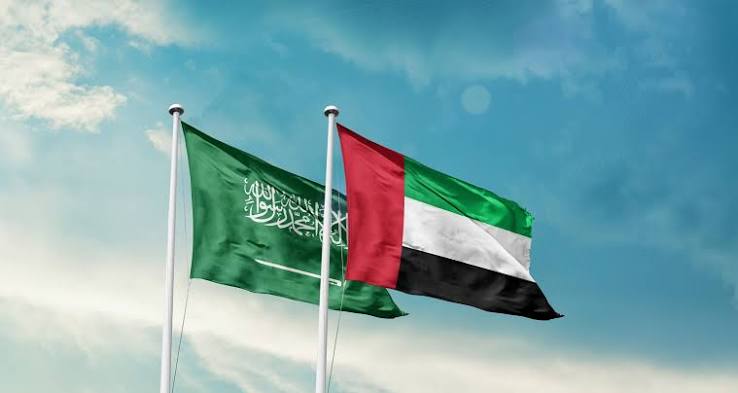
Saudi Arabia and the United Arab Emirates appear to be putting months of disagreements aside as growing threats from Iran and the Iran-backed Houthi terror group place new pressure on Gulf security.
The two countries had clashed over oil production quotas, regional policy, and competing interests in Yemen. However, the possibility of further Iranian attacks and a Houthi blockade of Red Sea shipping has increased calls for unity among the Gulf Cooperation Council states.
Against that backdrop, senior Saudi and Emirati officials published coordinated social media messages emphasizing their shared history, close ties, and common future. The posts were widely viewed as a public signal that Riyadh and Abu Dhabi are moving toward reconciliation at a time of rising regional danger.
The message was reinforced by a photograph showing Saudi Defense Minister Khalid bin Salman and UAE Vice President Mansour bin Zayed smiling with their arms around each other. UAE presidential adviser Anwar Gargash responded with a message stressing that unity creates strength.
Houthi Blockade Threat Turns Political Unity Into a Security Necessity
The immediate pressure behind the renewed Saudi-Emirati unity is the Houthi threat to block ships connected to Saudi ports from passing through the Bab el-Mandeb Strait.
The narrow waterway connects the Red Sea to the Arabian Sea and has become especially important because Saudi Arabia has been using its Red Sea port of Yanbu as an alternative export route amid disruptions around the Strait of Hormuz.
The Houthis reportedly warned international shipping companies not to load or unload cargo at Saudi ports. The terror group later claimed that several vessels changed course after receiving its warnings, although complete details about all of the ships have not been independently confirmed.
Shipping reports indicate that at least two tankers carrying Saudi crude turned around, while other commercial vessels either stopped their voyages or redirected north toward the Suez Canal.
Tanker Rerouting Raises the Risk of a Global Supply Shock
The vessel movements show that the Houthi threat is no longer being treated as empty rhetoric. Shipping companies and oil refiners are already preparing for the possibility that the normal route through Bab el-Mandeb may become too dangerous.
Saudi Arabia currently moves large volumes of crude through the east-west pipeline to Yanbu. Reports estimate that approximately four million barrels per day are being loaded there, with roughly 2.5 million barrels continuing through Bab el-Mandeb toward Asian markets.
If both the Strait of Hormuz and Bab el-Mandeb become unreliable, analysts warn that routes handling as much as 25% of the global oil supply could be affected. That does not mean one-quarter of the world’s oil would immediately disappear, but transportation delays, higher insurance costs, reduced shipping capacity, and longer routes could place severe pressure on the market.
Asian Refiners Consider a Four-Week Detour
Because the southern exit from the Red Sea is under threat, Asian refiners are considering moving Saudi crude in the opposite direction.
Under the proposed alternative, tankers would sail north from Yanbu toward Egypt, use the Suez Canal or the SUMED pipeline, enter the Mediterranean, travel around Africa’s Cape of Good Hope, and then continue toward Asia.
South Korean refiner Hyundai Oilbank was reportedly searching for a large crude carrier capable of using the Suez and SUMED route. Fully loaded supertankers often cannot pass directly through the Suez Canal because of draft restrictions, requiring some oil to be transferred through the SUMED pipeline before being reloaded in the Mediterranean.
This detour could add as much as four weeks to the journey. The longer route would also increase fuel costs, freight rates, insurance expenses, and ultimately the price paid by refiners and consumers.
Shipping analysts say the growing number of tankers changing direction is clear evidence that operators are taking the Houthi threat seriously.
Trump Warns the United States Will Act
As the threat began affecting tanker movements, President Donald Trump was asked how the United States would respond if the Houthis attempted to close the Red Sea route.
“If that happens, we will take care of it,” Trump said.
His warning came as the Iran-backed terror group sought to threaten Saudi exports and one of the world’s most important commercial waterways.
The United States has previously used military force against Houthi positions after attacks on commercial shipping. Trump’s latest statement signaled that Washington would not accept an attempt by an Iranian proxy to control international trade routes through terrorism and intimidation.
A Regional Threat With Global Consequences
The developing crisis explains why Saudi Arabia and the UAE are now emphasizing unity despite their recent disputes. A Houthi blockade would not only threaten Saudi oil exports. It would also damage Gulf economies, disrupt Asian energy supplies, raise global prices, and give Iran’s terror network leverage over international commerce.
For Riyadh and Abu Dhabi, cooperation is therefore becoming a security necessity rather than a symbolic diplomatic gesture.
The Houthis must not be allowed to hold global energy markets hostage. The United States and its regional allies must keep the shipping lanes open, protect commercial vessels, and confront the Iran-backed forces responsible for destabilizing the region.

Loading comments...