Saudi Arabia, Turkey and Pakistan Reportedly Sign NATO-Style Joint Defense Pact | Achla News
world
Saudi Arabia, Turkey and Pakistan Reportedly Sign NATO-Style Joint Defense Pact
Saudi Arabia, Turkey and Pakistan have reportedly signed a three-way defense agreement in Mecca establishing a NATO-style collective defense framework. The emerging Sunni security bloc could reshape the Middle East, combining Saudi financial power, Turkey’s growing defense industry and nuclear-armed Pakistan’s military capabilities.
Saudi Arabia, Turkey and Pakistan have reportedly signed a major trilateral defense agreement establishing a collective security framework among three of the Islamic world’s most powerful militaries.
Saudi Crown Prince Mohammed bin Salman, Turkish President Recep Tayyip Erdogan and Pakistani Prime Minister Shehbaz Sharif met in Mecca and signed what was described as the Mecca Joint Defense Agreement.
A NATO-Style Defense Commitment
The central provision reportedly treats an attack against any one of the three countries as an attack against all three, creating a collective-defense commitment similar in principle to NATO’s Article 5.
In a joint statement, the leaders described the agreement as being built around Islamic solidarity and cooperation between the three countries.
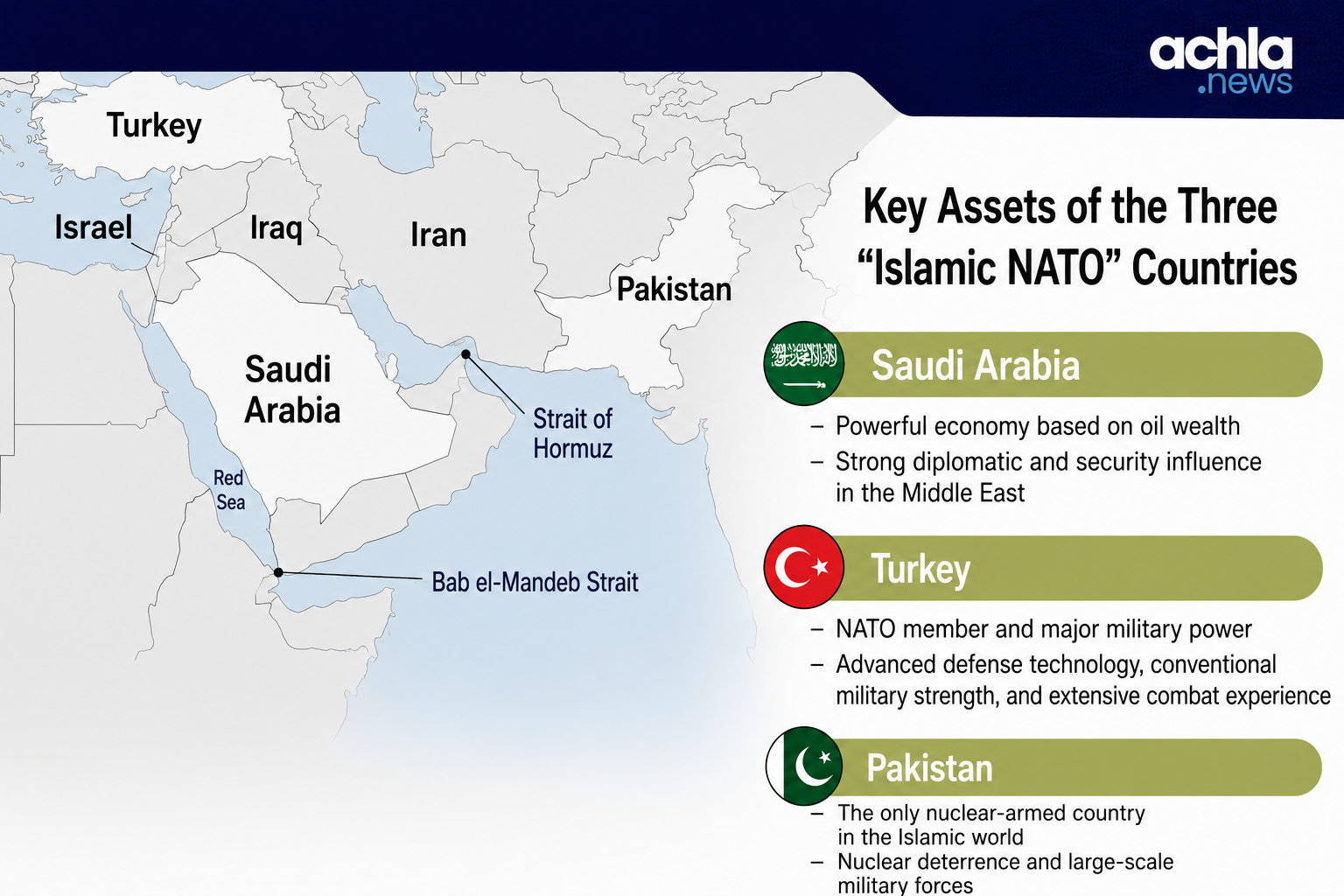
The emerging alliance brings together three very different sources of power: Saudi Arabia’s enormous financial resources and regional influence, Turkey’s expanding defense industry and large conventional military, and Pakistan’s nuclear arsenal.
Together, the three countries have a population of roughly 380 million people.
Regional Security Order Could Shift
The agreement comes during a period of extraordinary instability across the Middle East and reflects growing efforts by regional powers to strengthen security arrangements beyond their traditional alliances.
All three countries are majority-Sunni Muslim states and have complicated relationships with Shiite-led Iran.
Saudi Arabia and Pakistan had already moved toward deeper military cooperation through a strategic mutual defense arrangement. Turkey’s involvement significantly expands the potential military and geopolitical weight of the partnership.
For Riyadh, protecting strategic waterways remains a central concern. The Strait of Hormuz, the Red Sea and the Bab el-Mandeb are critical routes for Saudi energy exports and global commerce.
Pakistan, meanwhile, has long maintained close economic and security relations with Saudi Arabia. Riyadh has repeatedly provided Islamabad with financial and energy assistance during periods of economic crisis.
Turkey enters the partnership as both a NATO member and an increasingly independent regional military power. Ankara has built a major defense-export industry and expanded its military footprint across Syria, Libya and other regional theaters.
Israel Will Be Watching Closely
For Israel, the long-term direction of the new alliance will matter more than its branding.
Saudi Arabia remains an important American security partner, while Turkey under Erdogan has repeatedly taken hostile political positions toward Israel and maintained ties with Hamas. Pakistan does not maintain diplomatic relations with Israel and possesses nuclear weapons.
A defensive framework focused on containing Iran and protecting regional trade routes could overlap with Israeli security interests. However, a broader ideological Sunni military bloc increasingly positioned against Israel would create a very different strategic challenge.
Israel will therefore be watching closely to determine whether the agreement remains primarily defensive or develops into a larger political and military coalition capable of reshaping the balance of power across the region.
Could the Alliance Expand?
Egypt has also been mentioned as a possible future participant. Cairo has recently increased diplomatic and security coordination with Saudi Arabia, Turkey and Pakistan, raising speculation that the three-country framework could eventually grow.
Other Gulf states could also consider deeper participation if regional instability continues.
A wider Sunni military alliance would have consequences far beyond the Middle East. Pakistan’s rivalry with nuclear-armed India, Turkey’s NATO membership and Saudi Arabia’s close relationship with Washington mean any expansion would intersect with several of the world’s most sensitive security relationships.
The agreement signals that major regional powers are increasingly interested in building their own deterrence structures. For Washington and Jerusalem, the critical question will be whether this new framework strengthens the anti-Iran security architecture—or eventually develops ambitions that challenge Israel and the existing U.S.-led regional order.

Loading comments...