Why Stablecoins Create Demand for U.S. Government Debt
The second part of the strategy concerns reserves.
Regulated dollar stablecoins need high-quality liquid assets behind their liabilities. Cash and short-term U.S. Treasury securities are natural reserve assets because they are highly liquid and denominated in the same currency as the stablecoin itself.
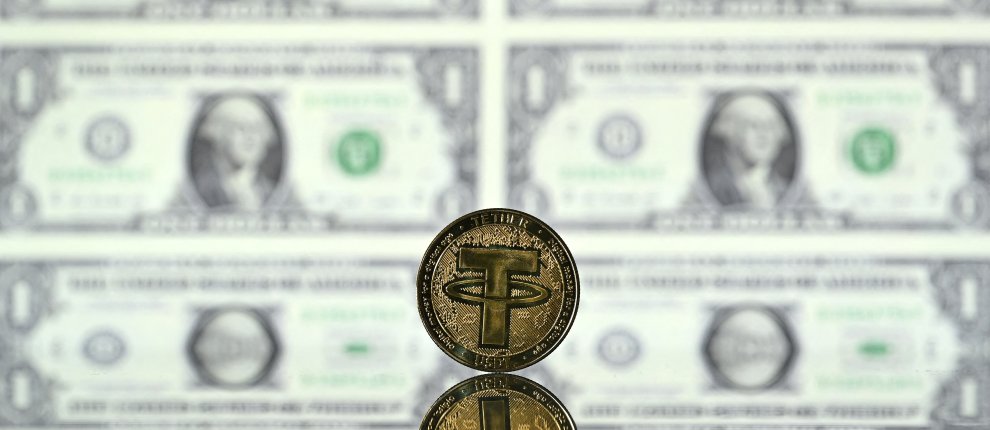
The mechanism is straightforward. Global users demand more dollar stablecoins. Issuers create additional tokens against reserve assets. Those reserves can include Treasury bills. At sufficient scale, expanding stablecoin circulation therefore creates another structural buyer of short-term U.S. government debt.
This matters because Washington faces an increasingly difficult fiscal equation. Federal debt continues to grow while some traditional foreign buyers are no longer accumulating Treasuries as aggressively as they once did. China, in particular, has substantially reduced its Treasury holdings from their previous peak.
Meanwhile, the enormous pool of excess liquidity that once sat in the Federal Reserve’s overnight reverse-repurchase facility has been largely drawn down. The Treasury consequently needs broader and more durable sources of demand as federal borrowing requirements continue to rise.
Stablecoins offer one possible source.
They will not solve America’s debt problem. The Treasury market is vastly larger than the stablecoin market, and federal debt can expand faster than stablecoin reserves. But even a partial new source of recurring demand becomes strategically valuable when Washington must continuously refinance and issue enormous quantities of debt.
The Most Valuable Stablecoin Customer May Not Be an American
This is where the strategy becomes much more powerful.
If an American moves money from a money-market fund into a stablecoin, the net benefit to Treasury demand may be limited. The money-market fund may already have owned Treasury bills. Capital has effectively moved from one Treasury-buying pocket to another.
If money leaves a bank deposit instead, there can also be costs. Large-scale deposit migration could weaken bank funding and reduce the traditional banking system’s capacity to create credit. Money pulled from equities could similarly create unwanted consequences elsewhere in American financial markets.
The more strategically valuable user is therefore potentially someone outside the United States who previously had little exposure to dollar assets.
Imagine a worker or business owner in a country suffering from persistent inflation or currency depreciation. Instead of saving in the local currency, that person can hold a dollar stablecoin on a smartphone.
The individual believes he is buying digital dollars.
Behind the scenes, the stablecoin issuer may be buying U.S. Treasury bills.
Washington has effectively gained a new indirect buyer of American government debt.
The China Scenario
The geopolitical implications become even more significant when China enters the equation.
Beijing has historically faced a difficult balancing act between supporting exporters, managing the yuan and preventing destabilizing capital flight. If dollar stablecoins become widely accessible and Chinese households or businesses seek protection from yuan depreciation through digital dollars, the process could reinforce demand for dollar-denominated assets.
In an extreme scenario, expectations of currency weakness could encourage greater stablecoin demand, which could create additional pressure on the domestic currency. That does not mean stablecoins automatically cause the yuan to collapse, nor does stablecoin growth guarantee a stronger dollar. Exchange rates depend on interest rates, trade flows, growth expectations, monetary policy and many other variables.
But the strategic direction is clear: widely accessible dollar stablecoins lower the technological barrier for people outside America to dollarize portions of their financial lives.
That could be particularly consequential in emerging markets with unstable currencies.
1974: The First Great Dollar Recycling System
There is an important historical precedent.
After President Richard Nixon ended the dollar’s direct convertibility into gold in 1971, the international monetary system entered a period of enormous uncertainty. Washington needed to preserve global demand for dollar assets in a world no longer anchored to Bretton Woods-era gold convertibility.
The strategic U.S.-Saudi financial relationship that emerged in the 1970s became one pillar of the new system. Saudi oil revenues were heavily recycled into dollar-denominated assets, including U.S. government securities, while the broader oil trade reinforced the dollar’s central role in global commerce.
The arrangement is sometimes simplified into the claim that Henry Kissinger negotiated a single secret “petrodollar deal” forcing all Saudi oil to be sold exclusively in dollars. The historical record is more complicated than that popular version. What did emerge in 1974 was a deep U.S.-Saudi economic and security partnership, including institutional mechanisms that helped recycle Saudi oil wealth into American assets.
The strategic principle matters more than the mythology surrounding the deal:
America strengthened demand for its currency by embedding the dollar inside something the rest of the world needed.
In the 20th century, that something was oil.
In the 21st century, it could be digital financial infrastructure.
From Petrodollar to Digital Dollar
The comparison reveals why stablecoin legislation deserves far more attention than the daily price of Bitcoin.
The old system linked global energy commerce, dollar settlement and recycling into American financial assets. A future stablecoin system could link digital commerce, international payments, tokenized assets and dollar-denominated reserves.
Oil created recurring demand for dollars because countries needed energy.
Digital dollars could create recurring demand because individuals and businesses need payments, savings, remittances, trading liquidity and eventually blockchain-based credit.
The potential distribution network is also radically different. The petrodollar system depended heavily on governments, banks and international institutions. Stablecoins can reach individuals directly through exchanges, wallets and smartphones.
That means the next expansion of dollarization could happen from the bottom up rather than exclusively from the top down.
America’s Two-Track Crypto Strategy
Bitcoin and stablecoins should therefore not necessarily be viewed as competitors in Washington’s emerging digital-asset strategy.
They can perform different functions.
Bitcoin can serve as a scarce digital reserve asset and collateral outside the traditional fiat system. Stablecoins can extend the dollar into blockchain markets while creating demand for dollar reserve assets. Ethereum and other programmable networks can provide the infrastructure on which those dollars move, settle and interact with tokenized financial products.
A future financial system could therefore involve consumers spending, borrowing and repaying in dollar stablecoins while Bitcoin or other digital assets increasingly serve as collateral.
This is also why the battle over blockchain infrastructure matters. Ethereum already hosts a substantial stablecoin economy. Other networks are competing for the same activity. Banks, payment companies, exchanges and eventually technology platforms all have incentives to become gateways into this ecosystem.
Smartphone manufacturers could eventually matter as well. If wallets and blockchain payments become native functions of consumer devices, control over the device can become an important point of access to the digital-dollar economy.
Bitcoin Does Not Need CLARITY as Much as the Rest of Crypto Does
The Senate rewrite of CLARITY underscores another important point: this is not simply a Bitcoin bill.
Provisions protecting legitimate self-custody and non-custodial software development could have significant consequences for the broader industry. Provisions allowing banks and credit unions to participate more directly in custody, lending, brokerage and blockchain infrastructure could also accelerate institutional adoption.
Bitcoin, however, already occupies a comparatively established position. Spot ETFs opened the door to institutional capital beginning in 2024, helping integrate Bitcoin more deeply into conventional portfolio management. Greater institutional participation may also contribute over time to a different market structure than Bitcoin experienced during its earlier retail-dominated cycles.
Ethereum could have a more direct structural connection to the stablecoin boom because it functions as infrastructure for stablecoins, decentralized finance and tokenized assets. XRP and other digital assets could also benefit if Washington eventually provides sufficiently clear commodity-versus-security classifications, although any investment outcome remains dependent on the final legislation and market adoption.
Liquidity Still Matters for Bitcoin
None of this eliminates the traditional macroeconomic forces driving cryptocurrency prices.
Bitcoin has historically shown a meaningful relationship with global liquidity conditions, and investors closely watch measures such as M2, real interest rates and central-bank policy. A sustained expansion in liquidity can support risk assets, while tightening financial conditions can work in the opposite direction.
Stablecoin growth adds another layer of crypto-native liquidity. But rising stablecoin supply should not automatically be interpreted as bullish for Bitcoin. Stablecoins can represent capital waiting to buy crypto, but they can also represent investors fleeing volatility and seeking dollar exposure.
The reason for rising stablecoin demand therefore matters as much as the quantity.
The Strategy Has Serious Risks
There is another side to this monetary revolution.
If dollar stablecoins become extraordinarily successful, they could weaken monetary sovereignty in countries with unstable currencies. Citizens may increasingly choose private digital dollars over their own governments’ money, making domestic monetary policy less effective.
There is also a geopolitical contradiction for Washington.
America’s control over dollar clearing and the international banking system has long made financial sanctions an exceptionally powerful national-security weapon. Blockchain payments can bypass parts of the traditional correspondent-banking and SWIFT infrastructure.
North Korea, Iran, Russia and other sanctioned actors therefore have powerful incentives to exploit digital-asset networks. American policymakers face the difficult task of expanding dollar stablecoins without simultaneously building a global financial highway for sanctions evasion, terrorist financing or hostile states.
Reserve safety presents another challenge. Treasury bills are highly liquid, but a stablecoin is not identical to an insured bank deposit. Redemption rules, reserve composition, liquidity management and regulatory oversight remain essential if stablecoins are to operate at enormous scale.
Nor should Treasury-backed stablecoins be confused with the Federal Reserve printing new money. Issuers generally transform existing dollars or dollar assets into blockchain-based liabilities. They can increase the transactional usefulness of those assets, but that is different from direct central-bank monetary creation.
Stablecoins Cannot Fix Washington’s Debt Addiction
The most dangerous mistake would be believing that stablecoins somehow eliminate America’s fiscal constraints.
They do not.
Even explosive stablecoin growth would represent only a fraction of the enormous U.S. Treasury market. If federal borrowing continues expanding much faster than stablecoin reserves, digital-dollar demand can alleviate Treasury financing pressure without solving the underlying deficit problem.
The United States still needs economic growth, credible fiscal policy and deep global confidence in American institutions.
Stablecoins can strengthen the dollar system. They cannot substitute for responsible government.
September 15 Could Be One Step Toward a New Monetary Order
This is why the CLARITY Act should be viewed alongside America’s broader stablecoin framework rather than as another piece of cryptocurrency legislation.
The September 15 vote will not determine whether Bitcoin succeeds or fails. It will not instantly transform the Treasury market. And it certainly will not guarantee perpetual dollar dominance.
But Washington appears increasingly determined to ensure that if finance moves onto blockchains, the dollar moves there first.
The strategy is powerful because it does not require America to defeat cryptocurrency. It allows America to absorb cryptocurrency into a dollar-centered financial architecture.
Half a century ago, Washington helped reinforce the dollar’s global position by tying American finance to the most strategically important commodity of the industrial economy and recycling enormous foreign surpluses into U.S. assets.
The next version could be more decentralized, more private and vastly more accessible.
Instead of oil fields, the distribution points could be blockchains. Instead of governments and central banks being the primary gateways, they could be exchanges, payment companies and smartphones. Instead of oil exporters recycling dollars into Treasuries, millions of people around the world seeking digital dollars could indirectly generate demand for American government debt.
That is the real significance of the stablecoin revolution.
The petrodollar helped America dominate the financial architecture of the industrial age. The digital dollar could become Washington’s attempt to dominate the financial architecture of the internet age.

Loading comments...