John Robison and the Exposure of the Illuminati
Two books published at the end of the 18th century played an enormous role in spreading the belief that the Illuminati had orchestrated or radicalized the French Revolution.
French Jesuit Augustin Barruel published Memoirs Illustrating the History of Jacobinism, while Scottish scientist and Freemason John Robison published Proofs of a Conspiracy Against All the Religions and Governments of Europe, Carried On in the Secret Meetings of Free Masons, Illuminati, and Reading Societies in 1797.
Both works presented variations of the argument that Illuminati members had infiltrated Masonic organizations and helped push Europe toward revolution. The books attracted significant attention and their ideas quickly reached the United States.
Robison was not an obscure writer. He was a professor at the University of Edinburgh and an accomplished scientist. His contemporaries included some of the leading figures of the Scottish Enlightenment.
After Robison's death in 1805, James Watt, one of the central figures in the development of the steam engine, praised his intellectual and scientific abilities.
One detail made Robison particularly significant to later debates: he was himself a Scottish Freemason.
That fact matters for two reasons.
First, Robison said that he had come into contact with Continental Illuminati circles and had been invited to participate in them. He ultimately rejected what he believed the organization represented.
Critics of Illuminati theories sometimes overlook Robison's own Masonic background, while supporters frequently point to it as evidence that his warnings came from someone familiar with secret societies from the inside.
Robison was also a Scottish Protestant, and his objections to the Illuminati appear to have been strongly connected to his belief that radical secret societies threatened Christianity and established government.
In his 1797 book, Robison accused revolutionary secret organizations of using writers, schools, reading societies and inexpensive publications to influence public opinion.
“They hired an army of writers; they industriously pushed their writings into every house and every cottage. Those publications were distributed in order to inflame men's sensual appetites and distort their judgment. They attempted to gain control of schools, particularly those educating the young, and established numerous circulating libraries and reading societies.”
“Under the name of economists, they pretended to devote themselves to plans for encouraging commerce, industry, agriculture and finance, occasionally publishing celebrated essays on such subjects. But their favorite project was the destruction of Christianity and all religion and the production of a complete change of government.”
“They employed authors to prepare corrupt and irreligious books, which were discussed in reading societies and revised until suitable for their purpose. Many were handsomely printed for sale, while still more were printed as cheaply as possible and distributed freely or supplied at very low prices to traveling sellers and retailers, with instructions to spread them secretly through towns and cities.”
Second, Robison's work became connected to George Washington.
In 1798, G. W. Snyder sent Washington a copy of Robison's book and corresponded with him about the Illuminati.
Washington's surviving correspondence is sometimes cited in Illuminati literature, but it is frequently mischaracterized. Washington acknowledged that Illuminati doctrines and Jacobin ideas had reached America. At the same time, he specifically rejected the suggestion that American Masonic lodges as a whole had been corrupted by the Illuminati.
Thomas Jefferson, another prominent American associated with Freemasonry in popular historical discussion, also wrote sympathetically about Weishaupt's intellectual ambitions, describing him in much more favorable terms than Robison had.
Freemasons and Illuminati Sympathizers Were Not a Single Revolutionary Bloc
Even among people influenced by Freemasonry, Enlightenment philosophy or ideas associated with the Illuminati, there was no single political position during the French Revolution.
Internal divisions were enormous.
Lafayette, for example, represented the moderate constitutional wing of the Revolution. He supported maintaining a monarchy while limiting royal power through a constitution.
Moderate Freemasons and liberal aristocrats often favored religious tolerance, greater civil liberties, economic reform and constitutional government rather than the complete destruction of the monarchy.
As the Girondins and Jacobins gained influence, however, the moderate Feuillant faction declined.
The Duke of Orléans followed a different political path. As a powerful figure connected with the Grand Orient, he developed his own political network and was widely suspected of harboring ambitions involving the French throne.
General Charles François Dumouriez later turned against the revolutionary government and attempted unsuccessfully to rally military support against it. Orléans himself ultimately became a victim of the Revolution and was executed during the Terror.
Other factions pursued far more radical objectives, including abolition of the monarchy.
Even within the Jacobins there were bitter struggles involving Georges Danton, Jean-Paul Marat, Robespierre and their respective political allies.
Some revolutionary figures may have encountered ideas similar to those promoted by Weishaupt's Illuminati, but that does not demonstrate that they remained under Weishaupt's command or operated as a unified secret organization.
Adam Weishaupt's Later Years and the End of the Illuminati
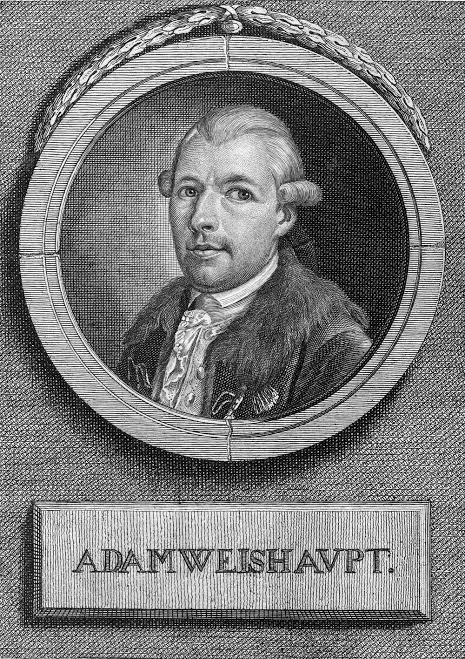
Adam Weishaupt continued writing after the Bavarian government suppressed his organization. His writings and correspondence remained part of political and intellectual discussions surrounding secret societies and revolution.
Following the execution of Louis XVI in January 1793, fear of revolutionary radicalism spread across Europe, accompanied by rumors that Freemasons and other secret societies were behind the upheaval.
Philippe Égalité, the former Duke of Orléans and a prominent Freemason, was himself executed on November 6, 1793.
Georges Danton, another revolutionary figure frequently linked by later writers to Masonic networks, lost his struggle with Robespierre's faction and was executed on April 5, 1794.
Robespierre's government then fell during the Thermidorian Reaction. Robespierre was executed on July 28, 1794, and the French Revolution entered a new phase that eventually produced the Directory.
Emmanuel Joseph Sieyès, one of the Revolution's most influential political thinkers, became increasingly pragmatic as France moved away from the ideological politics of the Terror.
Whatever influence radical Enlightenment and secret-society ideas may once have exercised, France's revolutionary leaders were increasingly consumed by practical struggles for political and military power.
Weishaupt, meanwhile, lived in exile and continued defending his ideas in writing. Claims that he directly controlled the later French revolutionary governments have never been convincingly demonstrated.
On November 9, 1799 — 18 Brumaire under the revolutionary calendar — Napoleon Bonaparte seized power in a coup and became First Consul. Joseph Fouché played an important role in the political system surrounding Napoleon.
Both Napoleon and Fouché had connections to revolutionary politics. Napoleon had previously been associated with Augustin Robespierre, the younger brother of Maximilien Robespierre, and those political connections helped his early career. After the fall of the Robespierres, Napoleon was briefly arrested because of those associations.
Fouché had been one of the Revolution's most ruthless political operators. He later became a powerful minister of police and developed an extensive surveillance network.
Under Napoleon and during the Bourbon Restoration, European governments closely monitored political organizations and secret societies. Some Masonic organizations survived or later re-emerged, but the original Bavarian Illuminati had already ceased functioning as the organization established by Weishaupt.
Adam Weishaupt spent the remainder of his life in Gotha under the protection of Duke Ernest II of Saxe-Gotha-Altenburg. He died in 1830.
The 20th-Century Revival of the Illuminati Myth and Nesta Webster
Although the historical Bavarian Illuminati had disappeared, the organization returned dramatically to popular conspiracy literature in the 20th century.
One of the most important figures behind this revival was Nesta Helen Webster, who lived from August 24, 1876, to May 16, 1960.
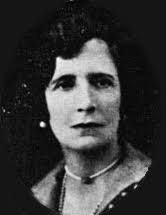
Webster was a British far-right conspiracy theorist and author who revived and expanded older claims about the Illuminati.
In books published during the 1920s, she argued that secret organizations had survived through interconnected networks involving the Illuminati, Freemasons, Jesuits and what she portrayed as a Jewish or Rothschild cabal seeking global power.
She blamed such forces for a vast range of historical events, including the French Revolution, the revolutions of 1848, World War I and the Bolshevik Revolution.
Webster also treated the notorious Protocols of the Elders of Zion as potentially genuine and promoted antisemitic allegations about Jewish influence.
The Protocols are a proven antisemitic forgery, not an authentic record of a Jewish conspiracy.
Webster's worldview increasingly overlapped with the ideological antisemitism that became prominent in fascist movements. She expressed admiration for Adolf Hitler and used conspiracy theories that helped rationalize or excuse the persecution of Jews in Nazi Germany.
Similar antisemitic ideas were promoted in the United States by industrialist Henry Ford and publications connected to him. Ford's newspaper, The Dearborn Independent, helped spread versions of the Protocols and other antisemitic material to a mass American readership during the 1920s.
Ford's antisemitic writings also became admired within Nazi circles, including by Hitler.
Webster's beliefs extended beyond conventional historical interpretation. After reading letters written by the Countess of Sabran, she reportedly came to believe that she herself was the reincarnation of someone who had lived during the French Revolution.
Other writers pushed the conspiracy theory even further.
In 1924, Arthur Cherep-Spiridovich published material combining Satanism, Freemasonry, the Illuminati, the Rothschild family and Jews into a sweeping racial and political conspiracy theory.
“Satanism = Freemasonry = Illuminati = Rothschild = Jews = Mongol race = evil.”
This formulation demonstrates how an 18th-century secret society became absorbed into an explicitly antisemitic worldview bearing little resemblance to the documented history of Weishaupt's original organization.
The Illuminati Card Game and the Return of the Conspiracy Theory
Illuminati conspiracy theories lost some of their cultural prominence after World War II, while fictional visions of centralized authoritarian control — most famously George Orwell's 1984 — became a much more recognizable framework for discussing hidden power and mass surveillance.
The Illuminati narrative returned strongly to popular culture decades later, particularly around the presidency of George W. Bush and in the aftermath of the September 11, 2001 terrorist attacks.
One unusual part of that revival involved the Illuminati: New World Order card game released by Steve Jackson Games in 1995, along with later expansions and related Illuminati-themed products.
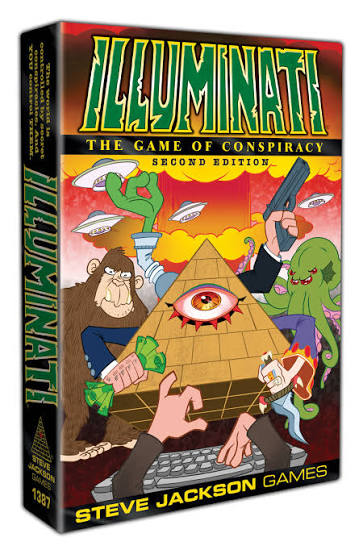

After 9/11, images of individual cards began circulating online alongside claims that the game had somehow predicted the terrorist attacks or other future disasters.
Some cards became famous because their artwork appeared, in retrospect, to resemble later real-world events.
There is no credible evidence that these cards were genuine predictions. The supposed matches rely largely on broad imagery, coincidence and interpretations made after the events occurred.
The game was created by Steve Jackson, an ordinary game designer and publisher. There is no credible evidence connecting him to a secret network of political or financial elites capable of predicting or arranging major world events.
Conclusion: What the History Actually Shows
The story of the Illuminati contains two very different histories that gradually became mixed together.
The first is documented history. Adam Weishaupt founded the Bavarian Illuminati in 1776. The group recruited intellectuals and some Freemasons, promoted radical Enlightenment ideas, operated secretly and was suppressed by the Bavarian government during the 1780s. France, meanwhile, entered revolution because of a complex combination of massive government debt, expensive wars, an unequal tax system, food shortages, political paralysis, Enlightenment ideas and growing opposition to absolute monarchy.
The second history is the mythology that developed afterward. Writers such as Augustin Barruel and John Robison argued that Illuminati influence had penetrated Masonic organizations and contributed to revolutionary radicalism. Later generations greatly expanded those arguments.
Nesta Webster transformed the theory into a sprawling 20th-century conspiracy narrative linking the Illuminati to the French Revolution, Bolshevism, global warfare, Freemasonry, the Rothschild family and Jews. Her work overlapped directly with the antisemitic conspiracy culture of her era and with the fraudulent Protocols of the Elders of Zion.
Modern popular culture added still more layers. The Illuminati became associated with global banking, celebrities, secret governments, the September 11 attacks and even a commercial card game whose illustrations were retrospectively described as predictions.
The historical record therefore supports the existence of an 18th-century Bavarian Illuminati and some overlap between its members and European Masonic circles. It also shows that revolutionary France contained numerous rival political factions, including moderates, constitutional monarchists, republicans and radical Jacobins who frequently fought — and sometimes executed — one another.
What the historical record does not establish is the existence of a single Illuminati command structure secretly directing the French Revolution, Napoleon, later revolutions, world wars or modern governments.
There is zero credible evidence that Adam Weishaupt's Illuminati continues to exist today as a hidden organization controlling world events.

Loading comments...