From Yemeni Unification to Houthi Control
The Houthi movement emerged in northern Yemen during the 1990s and later fought repeated wars against the central government. After years of instability and the political upheaval that followed the Arab Spring, Houthi forces seized the capital, Sana’a, in 2014.
The takeover triggered a wider civil war. A Saudi-led coalition intervened in 2015 in support of Yemen’s internationally recognized government, while Iran expanded its political and military backing for the Houthis. The conflict gradually became part of the larger regional confrontation between Iran and its Arab rivals.
The Houthis now control Sana’a and much of northwestern Yemen, including territory overlooking the Red Sea. Their position gives an Iran-backed terror force the ability to threaten one of the world’s most important shipping corridors with missiles, drones, explosive boats, and attacks on commercial vessels.
Why the Strait Matters to Global Trade
The Bab el-Mandeb is not only an energy route. It is part of the primary maritime connection between Asia and Europe. Container ships, oil tankers, liquefied natural gas carriers, bulk vessels, and military ships all depend on access to the passage.
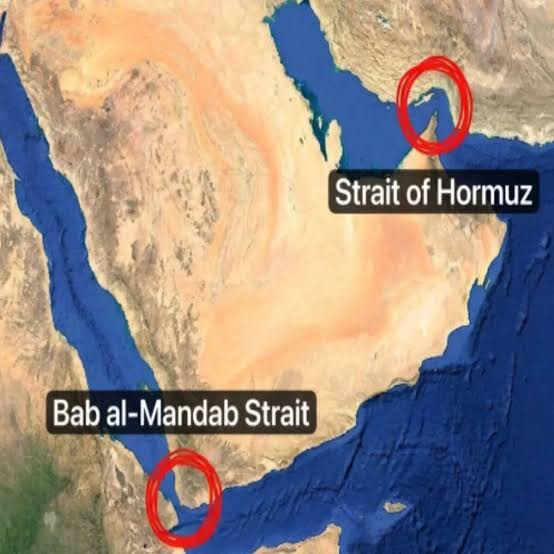
Unlike the Strait of Hormuz, which is especially important for Persian Gulf energy exports, the Bab el-Mandeb supports a much broader range of international trade. Goods manufactured in Asia move through the strait toward Europe, while European industrial products, machinery, food, and consumer goods travel in the opposite direction.
The strait also connects Red Sea ports and pipelines to Asian markets. Saudi Arabia can move oil through its East-West pipeline to the Red Sea port of Yanbu, reducing its dependence on the Strait of Hormuz. From there, tankers traveling toward Asia must pass through the Bab el-Mandeb.
This makes the route strategically important during any crisis involving Iran, the Strait of Hormuz, or Persian Gulf shipping. If one chokepoint becomes dangerous, pressure immediately shifts toward the others.
The Global Impact of a Blockade
A complete or prolonged closure of the Bab el-Mandeb would force many ships to avoid the Red Sea and sail around the Cape of Good Hope at the southern tip of Africa. Depending on the ports involved, the diversion can add thousands of miles and roughly one to two weeks to a voyage.
Longer journeys require more fuel, additional crew time, higher insurance premiums, and greater use of ships that would otherwise be available for other routes. The result would be higher freight rates and tighter global shipping capacity.
Those costs would eventually reach businesses and consumers. European and Asian importers would pay more for energy, industrial materials, food, machinery, and consumer products. Supply chains operating with limited inventories would face delays, while inflationary pressure could return to economies already struggling with high transportation and energy costs.
The consequences would extend well beyond the Middle East. A disruption at the Bab el-Mandeb could affect factories in Asia, retailers in Europe, energy markets in East Asia, and agricultural exporters dependent on predictable shipping schedules.
Lessons From the Suez Canal Disruption
The grounding of the Ever Given in the Suez Canal in March 2021 demonstrated how quickly a single obstruction can disrupt international commerce. The canal was blocked for six days, delaying hundreds of ships and creating severe congestion across global supply chains.
A Bab el-Mandeb crisis could be more difficult to resolve. The Ever Given incident involved a grounded commercial vessel in a controlled waterway. A military blockade would involve missiles, drones, naval patrols, intelligence operations, and the threat of repeated attacks across a far larger area.
Even without a formally declared closure, the danger of attack can produce similar economic effects. Shipping companies may suspend operations, insurers may raise premiums, and crews may refuse assignments through a high-risk zone.
Pressure on South Korea and Japan
South Korea and Japan would be especially vulnerable to a sustained disruption. Both countries rely heavily on imported energy and maintain major refining and manufacturing sectors linked to Middle Eastern crude.
Their refineries are designed to process large volumes of imported oil, and their economies depend on reliable maritime trade. Higher freight rates, longer delivery times, and greater competition for alternative supplies would place pressure on fuel prices and industrial costs.
China and India may have greater flexibility in dealing with sanctioned or politically isolated suppliers, including Iran. South Korea and Japan face tighter diplomatic and alliance constraints, limiting some of their options during a severe regional crisis.
The Houthis’ Geographic Advantage
Yemen’s rugged mountains provide the Houthis with a major defensive advantage. Missile launchers, storage facilities, command centers, and underground sites can be concealed across difficult terrain.
Outside powers have repeatedly struggled in Yemen. British forces faced resistance beyond the coastal regions. Egypt suffered heavy losses during its intervention in the North Yemen Civil War in the 1960s. The Saudi-led coalition, despite years of airstrikes and military pressure, failed to eliminate Houthi control in northern Yemen.
Air power can destroy exposed launch systems, radar sites, weapons depots, and command facilities. It is far more difficult to remove a deeply embedded movement that can relocate equipment, use mobile launchers, and operate among mountainous terrain and populated areas.
An Iran-Backed Threat to International Shipping
The Houthis have presented their maritime attacks as retaliation for regional military actions and as support for Hamas. In practice, their campaign has allowed Iran’s regional terror network to threaten global trade while maintaining a degree of distance from direct responsibility.
The strategy mirrors Iran’s use of other proxy forces, including Hezbollah in Lebanon and armed militias in Iraq and Syria. Tehran can pressure its enemies, disrupt commerce, and challenge the United States and its allies without immediately entering a conventional war.
Control over maritime chokepoints can be as strategically powerful as many advanced weapons. Iran has long used the threat of closing the Strait of Hormuz as leverage. The Houthis are attempting to create similar pressure at the southern entrance to the Red Sea.
The Risk of Regional Escalation
Saudi Arabia has strong reasons to avoid another major war in Yemen. The previous intervention was costly, prolonged, and failed to decisively defeat the Houthis. Riyadh also remains focused on economic development, regional investment, and protecting critical infrastructure from missile and drone attacks.
The Houthis, however, may calculate that maritime pressure increases their political leverage. Threatening shipping can force regional governments and international powers to respond, giving the terror group influence far beyond the territory it controls.
A renewed Saudi-Houthi confrontation could quickly expand. Additional missile attacks, strikes on ports or energy facilities, and direct Iranian involvement could pull the United States and other naval powers deeper into the conflict.
A Chokepoint the World Cannot Ignore
The Bab el-Mandeb Strait is a narrow passage with global consequences. Its history is tied to empire, colonial competition, Yemeni division, energy security, and the rise of Iran-backed terrorism.
A prolonged closure would not be a local maritime dispute. It would threaten the commercial artery connecting Europe and Asia, raise energy and transportation costs, weaken vulnerable economies, and hand Iran and the Houthis powerful leverage over international trade.
Protecting freedom of navigation in the Red Sea is therefore not optional. The United States, Israel, and their regional allies cannot allow an Iran-backed terror organization to gain permanent control over one of the world’s most important shipping routes.

Loading comments...