The Left speaks of equality and redistribution, but a powerful emotion often lies beneath these ideals: envy. Those with more wealth, status, or power become targets to be brought down in the name of reform or revolution.
During the French Revolution, Freemasons and the Illuminati championed reason, rationalism, and Enlightenment ideals. Yet revolutionary politics also became a means of destroying the aristocratic order, sending elites to the guillotine, and seizing their wealth and power. Bringing down those who once stood above them became a source of revolutionary euphoria.
This tradition continued with communism. After the 1917 Bolshevik Revolution, the Red Terror began in 1918. The Bolsheviks viewed society through class struggle, targeting aristocrats, landowners, capitalists, former officials, and alleged counterrevolutionaries. Property was confiscated, and many were imprisoned or executed.
During the Korean War, after North Korean forces invaded the South in 1950, class violence erupted in some occupied areas. Some tenant farmers participated in the killing of landowners who had once employed them.
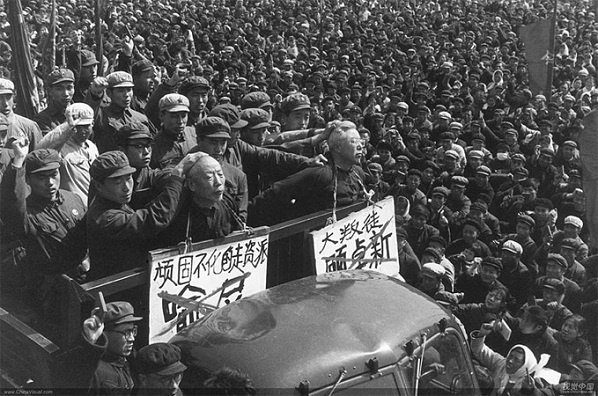
Mao’s Cultural Revolution in the 1960s followed a similar pattern. Children turned against parents and students against teachers. Those branded “reactionaries,” “counterrevolutionaries,” or “capitalists” could have their property seized, their authority stripped away, and be subjected to public humiliation.
Here lies the paradox: Communists began revolutions promising to abolish concentrations of power, only to create new regimes that monopolized violence in the name of defending the revolution.
Bertrand Russell argued that good philosophy requires a “kindly feeling.” In his criticism of Marxism, he argued that it was driven less by a desire for the happiness of the proletariat than by a desire for the unhappiness of the bourgeoisie. Russell saw this “unkindly feeling” as a force capable of producing tragedy.
David Rockefeller made a similar observation in his 2002 memoir. While studying at the London School of Economics, he attended lectures by the prominent leftist professor Harold Laski. Rockefeller came away believing that Laski was motivated less by compassion for the poor than by hostility toward the rich.
Rockefeller was born into extraordinary wealth and could hardly fully understand the hardships of ordinary people. But on this point, his observation rings true.
The Left presents social revolution as a struggle for equality, but envy often lies beneath it. Its followers may consider themselves politically and morally superior, yet that sense of superiority can become hypocrisy.

Loading comments...