Have Investors Already Priced In Too Much Growth?
A company can continue growing while its stock delivers weak returns for many years. Cisco after the dot-com bubble remains one of the clearest examples. Its revenue and earnings continued to expand, but the stock took roughly 25 years and eight months to return to its 2000 peak.
Cisco did not fail as a business. The valuation failed because investors had already paid for decades of future success.
That same risk now hangs over the AI semiconductor trade. The question is not whether AI demand will grow. It likely will. The more important question is whether current share prices already assume years of uninterrupted growth, high margins, limited competition, and endless customer spending.
When expectations become extreme, a stock does not need bad news to fall. Slower growth, weaker guidance, lower margin expansion, or a minor delay in customer spending may be enough to trigger a major correction.
Why Strong HBM Demand May Still Fail to Support Chip Stocks
High-bandwidth memory remains one of the most important components in advanced AI systems. Demand could remain strong through 2027, and supply constraints may continue supporting prices.
However, stock markets care about the direction of improvement. If HBM margins remain high but stop rising as quickly, investors may conclude that the most profitable phase of the cycle is approaching its peak.
Long-term supply contracts also do not eliminate every risk. Even contracts described as non-cancelable may contain provisions allowing changes in price, delivery schedules, specifications, or volume. These agreements provide visibility, but they do not guarantee unlimited pricing power.
This distinction is critical for U.S. semiconductor investors. A strong order backlog can support revenue, but the stock price may still fall if investors believe future margins will flatten or customers will eventually cut capital spending.
The Debt Question Behind the AI Boom
One of the most important risks is how AI infrastructure spending is being financed.
Large technology companies currently fund most capital expenditure through internally generated cash. According to the source analysis, approximately 94% of major technology companies’ capital spending is still financed through reinvested funds.
That is a relatively healthy foundation. The concern is what happens next.
As AI data-center spending grows, even the largest companies may increasingly use debt. Smaller cloud providers and so-called neocloud companies already depend more heavily on outside financing. If those companies borrow money to purchase expensive AI chips, semiconductor demand becomes tied to interest rates and credit conditions.
The historical warning comes from Lucent during the dot-com bubble. Lucent helped finance customers that then used the borrowed money to buy Lucent equipment. The arrangement boosted reported sales, but the demand proved fragile because the customers themselves were financially weak.
When credit conditions tightened, the structure collapsed.
The same principle applies today. If chipmakers, suppliers, or strategic partners help weaker AI companies obtain financing, reported demand may look stronger than the customers’ underlying finances justify.
This does not mean the current AI boom is identical to the dot-com bubble. It means investors should ask whether future chip purchases will be funded by sustainable cash flow or by increasingly expensive debt.
Why Interest Rates Matter to Semiconductor Demand
Some investors treat AI chips and HBM as if they are protected from interest-rate risk. That assumption is dangerous.
Higher rates raise borrowing costs for data-center projects, cloud companies, startups, utilities, and infrastructure developers. They also make it harder for weaker customers to refinance existing obligations.
If credit becomes more expensive, customers may postpone new data centers, reduce chip orders, or stretch existing equipment for longer. That pressure eventually moves through the supply chain—from cloud providers to GPU makers, memory companies, equipment suppliers, and foundries.
The direct exposure may appear first in smaller AI infrastructure firms, but it can eventually affect the largest U.S. semiconductor companies through weaker order growth.
China Could Change the Future of Memory Pricing
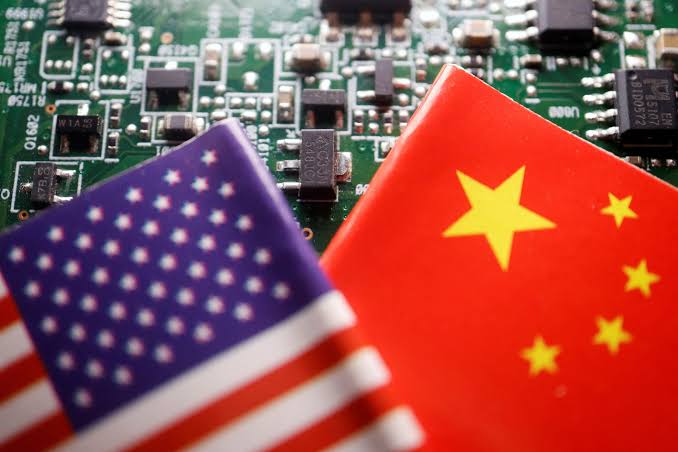
The second major structural risk is China’s rapid expansion in memory semiconductors.
ChangXin Memory Technologies, known as CXMT, has expanded with significant state support and is reportedly pursuing additional capital through an initial public offering. The source material estimates that its market share has risen from roughly 3% to 8% in a relatively short period.
CXMT is also working toward more advanced products, including HBM3-related development. YMTC and other Chinese semiconductor companies are expanding investment as well.
Chinese companies do not need to immediately overtake the global leaders in advanced AI memory to disrupt the market. They can pressure prices by increasing supply in conventional DRAM and other memory categories.
That matters because the global memory industry has benefited from a concentrated structure dominated by a small number of major suppliers. Fewer producers generally make it easier to control capital spending and protect pricing.
A large state-backed Chinese expansion could weaken that discipline. Chinese companies may prioritize market share, domestic independence, and strategic national goals over short-term profits.
If that happens, memory prices could come under pressure even while AI demand remains strong.
Why Korean Memory Stocks Matter to Wall Street
The weakness in Samsung Electronics and SK Hynix matters because both companies are deeply connected to the profitability of the global AI supply chain.
SK Hynix is a major supplier of advanced HBM used in AI accelerators. Samsung remains one of the world’s largest memory producers. When investors sell these companies despite strong earnings, they may be signaling concern about future margins, pricing power, customer financing, or the next stage of the memory cycle.
Those concerns can quickly spread to U.S. semiconductor stocks. Nvidia depends on a reliable supply of advanced memory. Micron competes directly in memory. Equipment companies depend on continued capital spending. Cloud providers depend on the economics of AI infrastructure.
This is why the Korean selloff should be interpreted as part of a larger global semiconductor warning, not as an isolated foreign-market event.
The Memory Industry Has Never Escaped the Cycle
Memory semiconductors remain a cyclical business. High prices lead to rising profits. Rising profits encourage companies to invest in new factories and capacity. That new supply eventually reaches the market, prices fall, and producers cut spending.
Every cycle produces claims that the old pattern has ended.
This time, the arguments include AI demand, long-term contracts, limited suppliers, and the technical difficulty of producing advanced HBM. These factors may extend the upcycle, but they do not remove the basic economics of supply and demand.
The phrase “this time is different” has repeatedly caused investors to underestimate risk. New technology can transform an industry while stock prices still fall because expectations became unrealistic.
Will Today’s Leaders Still Lead After the Next Downturn?
Major semiconductor downturns often change the identity of the winners.
Intel exited the DRAM business in 1985. Japanese companies later dominated the market. Samsung then rose during the U.S.-Japan semiconductor conflict. Qimonda collapsed in 2009, and Elpida failed in 2012. Each downturn reshaped the competitive order.
Investors should therefore avoid assuming that today’s leaders will remain dominant forever.
Nvidia, Micron, Samsung, SK Hynix, AMD, Broadcom, and other major semiconductor companies all have different strengths. But future leadership will depend on technology, capital discipline, customer demand, government policy, financing conditions, and the ability to survive the next downturn.
What Could Cause Another Leg Down?
Semiconductor stocks could face further pressure if several risks appear at the same time.
AI customers begin relying more heavily on debt.
Interest rates remain high or rise again.
HBM margin growth slows.
Chinese memory production expands faster than global demand.
Major cloud companies reduce capital-expenditure guidance.
Leveraged investors are forced to sell semiconductor shares.
New litigation or regulatory action affects memory pricing.
Any one of these factors may be manageable. Several occurring together could create a deeper and longer correction.
What Could Trigger a Recovery?
A stronger recovery would become more likely if major technology companies continue funding AI investment through cash flow, advanced-memory supply remains tight, Chinese competitors struggle to reach leading-edge production, and semiconductor valuations fall to more reasonable levels.
Investors should also watch whether HBM pricing remains firm, whether data-center projects generate real revenue, and whether smaller AI companies can survive without constant refinancing.
The central issue is not whether AI will continue. The central issue is whether the profits created by AI will be large enough, durable enough, and widely distributed enough to justify current semiconductor valuations.
What Investors Should Watch Next
Future earnings reports should be judged by more than headline revenue.
Investors should focus on capital-expenditure guidance, customer financing, memory pricing, HBM margins, order cancellations, long-term contract terms, Chinese production growth, and the financial health of neocloud companies.
A record quarter describes the past. Guidance describes management’s expectations. Credit conditions reveal whether customers can actually afford the next phase of expansion.
Conclusion: The Market Is Repricing the AI Future
The current decline in U.S. semiconductor stocks may not mean that the AI boom is ending. It may mean that investors are reconsidering how much future growth they are willing to pay for today.
The biggest risks are not limited to chip demand. They include excessive valuations, debt-funded data-center expansion, slowing margin growth, Chinese supply, rising interest rates, and the possibility that the next semiconductor downturn changes the industry’s leadership.
The future of chip prices will depend on whether demand continues growing faster than supply—and whether customers can finance that demand without relying on increasingly fragile debt.
That is the real message behind the semiconductor selloff. Wall Street is not simply reacting to today’s earnings. It is questioning whether the AI profits expected tomorrow have already been priced in.
This article is for informational purposes only and does not constitute investment advice.

Loading comments...